Elementary school dance ideas work best when they start with how children and families will actually use the night. Younger guests may arrive excited, hang back for the first song, then rush to join a familiar group dance five minutes later. Some want to dance with friends. Some prefer a photo with family, a game, or a quiet table before they enter the crowd. A successful event leaves room for all of that.
That is good news for a planning team. You do not need a complicated production or decorations in every corner of the gym. You need a clear theme, a few reliable moments, a safe room plan, and volunteers who know where to be. Use these ideas to build a dance that feels special for children while staying manageable for the adults bringing it to life.
Start with the kind of night children can picture
A theme should make the event easier to understand, not create a costume rule or a long shopping list. A glow night, sock hop, spring celebration, storybook color party, or school-spirit dance gives the invitation, entrance, music, and photo area a shared direction. Pick something visual enough for a child to describe at home in one sentence.
Before committing, check the date, venue, age range, and family format. A Friday glow dance may suit a gym that can be dimmed. A Saturday family dance may need brighter lighting, easier arrival signs, and room for adults at the edge of the floor. A class vote or a small student group can help choose between two or three workable themes. Their input builds anticipation, but adults should still choose the version that fits the room, time, and school rules.
For ideas that work across age groups and venues, the site’s school dance themes guide can help narrow a broad idea into a plan for the room. Keep the chosen theme simple enough that the entrance, one photo moment, and the dance space all feel connected.
Make the first ten minutes easy
Arrival is where an elementary dance either feels welcoming or starts with a knot of questions. Give families one obvious route from the door to check-in, and make the first thing children see feel like the event has already begun. A banner, color, lighted columns, or a themed backdrop at the edge of the entry creates that shift without getting in the way of the line.
Keep the check-in job deliberately simple. Decide in advance who welcomes families, who handles tickets or wristbands, where questions go, and how a child who arrives late gets oriented. Put the event schedule, pickup expectations, and any food details in the invitation as well as at the entry table. Clear information gives volunteers fewer last-minute explanations and lets children get to the fun sooner.

Give children more than one way to participate
Not every child wants to step into an open dance floor. That is normal, especially at the beginning of the night. Plan for participation in layers: an easy group song, a quick activity, a photo spot, and a calmer social area. When children can choose their own entry point, the dance floor fills more naturally than it does when everyone is pushed toward one big moment.
- Familiar group dances: Build in songs with repeatable moves so children can join without inventing their own dance steps.
- Short game breaks: Freeze dance, limbo, or a simple call-and-response challenge changes the pace and gives children a reason to come back to the floor.
- A photo moment: A well-lit backdrop with a few theme details gives families and friends a shared activity away from the speakers.
- A small hands-on station: Glow bracelets, a message wall, or a quick craft can work as an arrival activity or a reset between songs.
- A quiet edge: A few tables away from the loudest sound give children and adults a place to regroup without leaving the event.
Keep every activity easy to understand from a few feet away. If it needs a long explanation, a line, or a separate volunteer team to run all night, it may take more energy than it gives back. The best elementary school dance ideas are low-pressure and repeatable, so a child can join halfway through without feeling behind.
Use music to build confidence, not just volume
A playlist does more than provide background noise. It tells children when the room is ready to move. Start with familiar, upbeat songs while families are still arriving, then use a group-dance moment to make the first transition into the floor feel less awkward. Alternate bigger songs with a brief slower reset or an activity announcement, rather than trying to sustain peak energy for the entire event.
Build the playlist with school expectations in mind. Ask the school or event lead how music is reviewed, which versions are appropriate, and whether a DJ, staff member, or volunteer owns the final call. The school dance playlist guide has a useful framework for collecting input, checking the music, and pacing the night. At an elementary event, a predictable rhythm is more valuable than chasing every request.
Design the room around movement and breaks
Think about the room as a series of jobs: arrive, check in, dance, take a photo, get a snack, sit down, use the restroom, and leave. Sketch those spaces before moving in decorations or tables. The dance area should be easy to spot from the door, while food, check-in, and photo lines need to stay out of its edges. This is what keeps a gym from feeling like one crowded queue.
Accessible routes deserve the same attention as the decorations. The U.S. Department of Justice notes that accessible routes need to stay clear of obstructions, including furniture and temporary items. Treat that as a practical room-planning rule: keep paths to the entrance, exits, restrooms, and key activity spaces open, visible, and free of spare boxes, cords, or photo-area lines. Confirm the school’s own requirements with venue staff before finalizing anything.
Place seating where adults can supervise without forming a wall around the dance floor. A few tables at the edge of the room can provide a reset spot for children and a clear place for caregivers, while leaving the central energy visible. The site’s floor-size guide can help a team picture how a floor fits into the wider room plan before event day.
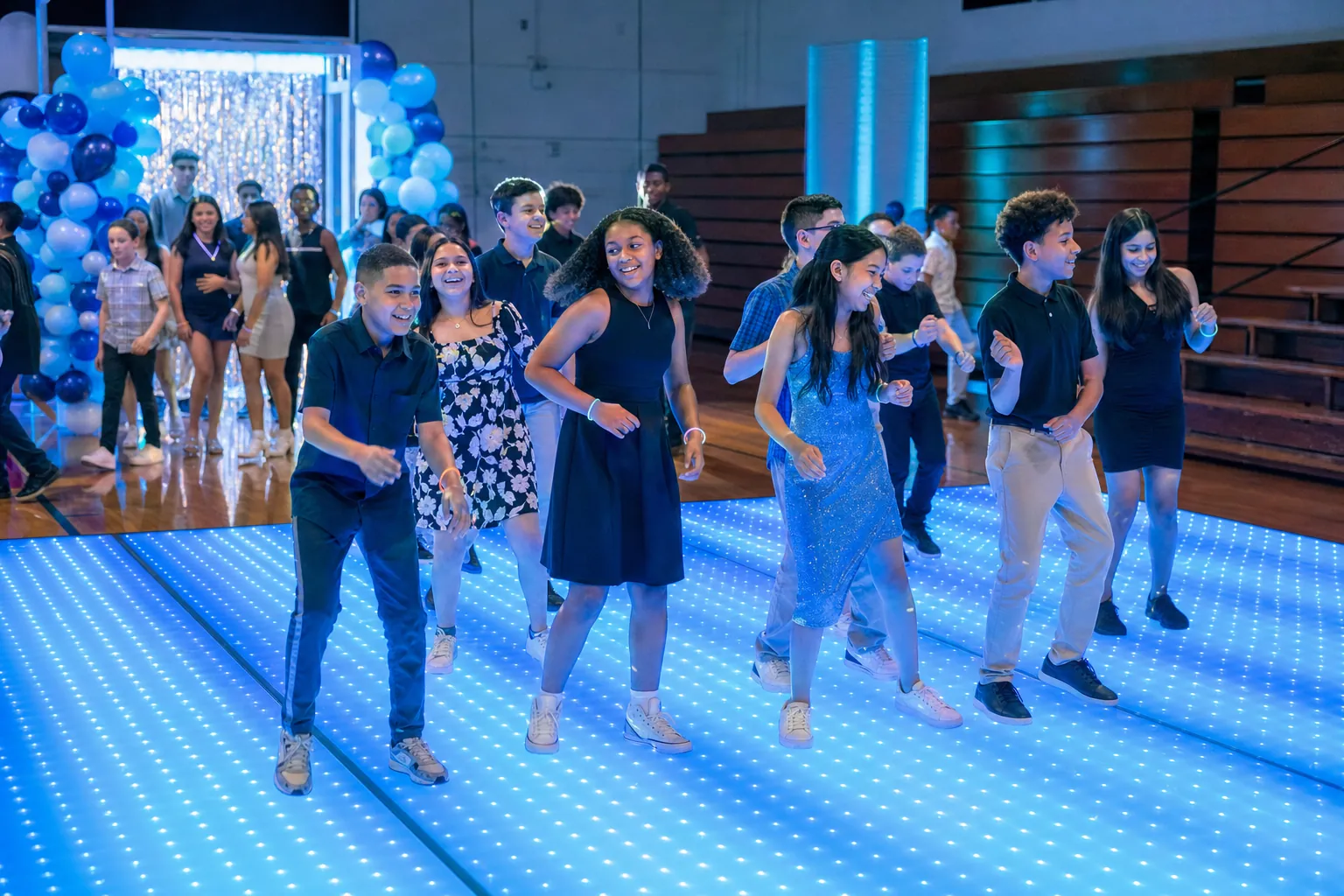
Decorate the moments children will remember
A small number of complete visual moments beats a gym full of unrelated props. Spend the effort where it changes how the evening feels: the entrance, the photo area, and the dance space. Repeating two or three colors across those points creates a finished look even when the tables and walls stay simple.
Use lighting carefully. A little color can make a familiar gym feel transformed, but check-in, exits, food, and walking paths still need enough light to work well. Avoid loose items on the floor and ask venue staff before hanging anything, plugging in equipment, or using special effects. The goal is a room that feels different from an ordinary school day, not a room that is hard to navigate.
For more focused setup ideas, the school dance decorations guide breaks down how an entrance, photo area, and dance zone can work together. Keep the final setup light enough that volunteers can install it calmly and clear it quickly after the last song.
Give volunteers clear places to be
An elementary school dance needs visible adults, but it should not feel over-managed. Put volunteers where a decision or transition happens: at the entrance, near the dance area, by snacks, near a quiet table, and around the exit at pickup. One event lead should have the room plan and a way to reach each area, while every volunteer knows who to ask when something changes.
Walk through the event before doors open. Can a family find check-in? Can a child get a drink without crossing a busy dance area? Are exits and restrooms easy to reach? Is there an obvious place to take a break? The broader school dance planning checklist is useful for assigning those final pre-opening checks. A short walk-through often catches the small details that make the night feel calm once people arrive.
Keep the night moving with a simple run of show
Children do not need a tightly scripted program, but a loose rhythm prevents the room from losing energy. Give the team a one-page outline that names what happens next and who is responsible. For a short evening, that could mean an arrival period with the photo area open, one familiar group dance, an activity break, another music block, a final shared song, and a clear pickup announcement. The specific times should follow school policy and the age group, but the sequence matters.
Build in transitions before the room needs them. Announce the photo area while a song is ending, invite a game before children get tired of standing around, and give families notice before the final song. Avoid long contests or a stack of announcements that stop the music too often. Children respond well to simple cues and quick wins, while families appreciate knowing that the event has a clear beginning, middle, and end.
Create a dance-floor moment that draws children in
The dance floor is often the visual center of the night, but it works best when it feels like an invitation rather than a stage. Give it a clear place in the room, leave enough open space around its edge, and start with a shared activity that makes joining easy. Children who do not want to dance right away can watch from the edge, return after a game, or join with a friend once the room feels comfortable.
Led Dance Floors Dallas can help a school team match a lighted floor to the venue, guest count, date, and setup access. A visible floor can give a simple gym a real event focal point while still leaving the rest of the room free for photos, refreshments, and family flow. Once the date and room are set, use the availability request to share the essential details.
Elementary school dance checklist
- Choose a simple theme children can recognize and families can understand from the invitation.
- Map the entrance, check-in, dance space, photo area, refreshments, quiet seating, restrooms, and exits before decorating.
- Keep walking routes and accessible paths clear throughout the event.
- Plan at least two low-pressure ways for children to participate besides freestyle dancing.
- Use a reviewed playlist with group moments and short reset points.
- Put volunteers at arrival, active areas, refreshments, breaks, and pickup.
- Confirm school and venue rules for music, food, lighting, setup, and supervision.
- Walk the room once before doors open, from a child and family point of view.
The right elementary school dance does not need to be elaborate. It needs a few joyful moments, clear choices for children, and a room that lets families relax. Start with those fundamentals, then let the theme and details make the night feel like something children will talk about long after cleanup.
Frequently asked questions
What makes an elementary school dance fun?
The best elementary school dances give children more than one way to join in. A familiar group dance, a simple game, a photo spot, and a place to take a breather make the night feel welcoming to confident dancers and cautious guests alike.
How long should an elementary school dance last?
A shorter, well-paced event is usually easier on children, families, and volunteers than a long program. Choose a schedule that matches the age group, then build in an arrival window, active moments, a small reset, and a clear closing plan.
What are easy activities for an elementary school dance?
Freeze dance, a limbo line, a family-friendly group dance, a themed photo area, and a simple craft or glow-bracelet station are easy to explain. The right activity is one that children can join without waiting through a long set of rules.
How do you make a school dance inclusive?
Keep the routes open, offer a quieter place away from the speakers, use a participation plan that does not require every child to dance, and make the information for families clear before the event. Venue rules and school policies should guide the final plan.
Related posts
SCHOOL EVENT PLANNING
School Dance Ideas: Activities Students Will Join
Give older students more ways to join through activities, music, and a room that keeps moving.
Read the guide ↗SCHOOL EVENT PLANNING
School Dance Themes: Ideas That Fill the Floor
Choose a theme that gives the whole event a clear, welcoming direction.
Read the guide ↗